
Plants
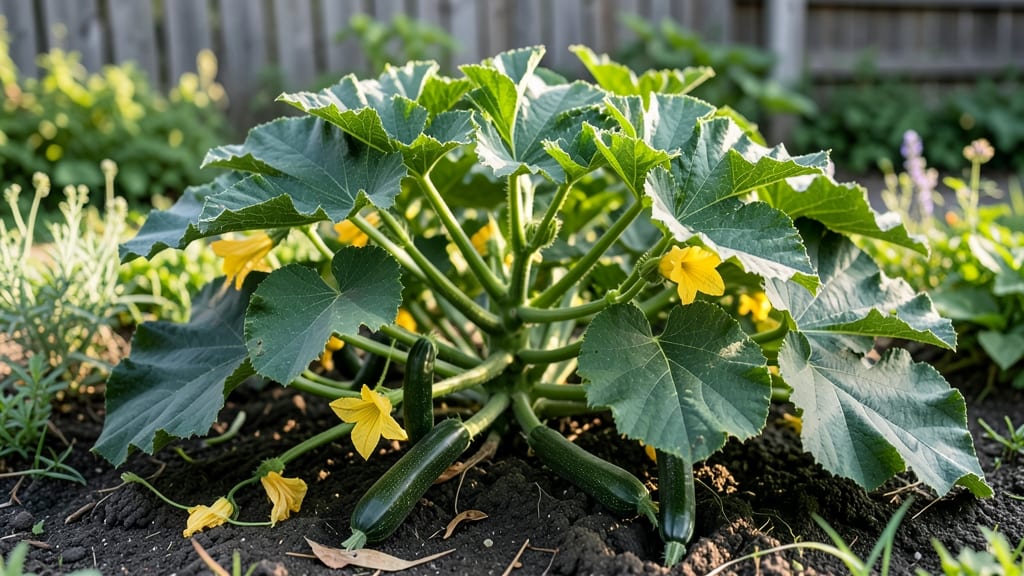
If you're wondering how tall your zucchini plants will grow, the answer depends on the variety you choose—some stay neatly contained at 1-3 feet, while others can soar up to 6 feet or more, turning your garden into a sprawling green jungle if you're not careful.
Understanding your zucchini's growth habits is the key to planning your garden layout and maximizing your harvest. Bush varieties like 'Black Beauty' stay compact, making them perfect for small spaces, while vining types like 'Straight Eight' need room to stretch or support to keep them upright.
Without the right approach, you could end up with tangled vines and missed opportunities for more produce.
Let me show you exactly how to work with your zucchini's natural growth patterns—whether that means spacing plants correctly, setting up trellises for vertical growth, or knowing when to prune for better air circulation and bigger yields.
You'll learn the best practices to keep your plants healthy and productive, no matter which variety you're growing.
From choosing the right spot in your garden to managing height as the season progresses, these insights will help you avoid common pitfalls and create the ideal conditions for a thriving zucchini patch. Ready to transform your garden planning?


Zucchini plant height by variety: compact vs. vining types explained
Zucchini plants come in two main growth forms: bush varieties that stay compact and vining types that climb aggressively. Understanding these differences helps you plan your garden layout, choose the right support, and avoid overcrowding.
For example, a bush zucchini like 'Black Beauty' typically reaches 3-4 feet tall, while a vining variety such as 'Straight Eight' can sprawl 6 feet or taller if unchecked.
Your garden design hinges on these height differences. Bush varieties are perfect for small spaces or containers, while vining types thrive with trellises or stakes. Even within these categories, some hybrids blur the lines—like 'Eight Ball,' which stays 2-3 feet tall but produces prolifically.
Always check seed packets for mature height estimates before planting.
Here’s how height impacts your harvest: taller vining varieties often yield more zucchini but require stronger support to prevent stem breakage. Meanwhile, bush types produce fewer fruits but are easier to manage in tight spaces.
My 2023 garden proved this—my 'Patio Star' bush zucchini gave me 12 zucchini in 4 sq ft, while my 'Defender' vining plants needed 6 sq ft each but produced 30 zucchini total with proper trellising.
🌱
| Variety Type | Mature Height | Spread | Best For | Spacing Needs |
|---|---|---|---|---|
| Bush Varieties | 1–3 ft | 2–3 ft wide | Containers, small gardens | 18–24" apart |
| Semi-Bush | 3–4 ft | 3–4 ft wide | Raised beds, trellises | 24–36" apart |
| Vining Varieties | 4–6+ ft | 4–6 ft wide | Large gardens, trellises | 36–48" apart |
| Dwarf Hybrids | 1–2 ft | 1–2 ft wide | Balconies, window boxes | 12–18" apart |
When selecting zucchini varieties, prioritize height based on your space. For example, if you have a 4-foot-tall fence, a 4-foot-tall 'Gold Rush' will work perfectly without trellising. But if you plant 6-foot 'Straight Eight' nearby, its vines will climb over your Gold Rush, stealing sunlight and reducing yields.
Always leave at least 3 feet between vining types and other plants.
Another key factor is stem strength. Taller vining zucchini often have weaker stems without support, leading to broken plants when heavy fruits develop. I learned this the hard way in 2022—my 'Defender' vines snapped under 3-pound zucchini, costing me half my harvest.
Now, I always use 6-foot stakes for vining types and prune lower leaves to encourage upward growth.
For container gardening, stick to bush or dwarf varieties like 'Eight Ball' or 'Patio Star'. These stay under 2 feet tall and thrive in 5-gallon pots with proper sunlight. Even so, rotate containers weekly to prevent one-sided growth, which can make plants lean or top-heavy.
A top-heavy zucchini plant in a pot is a recipe for tipped-over disasters—trust me, I’ve seen it happen!
If you’re growing zucchini in rows, account for both height and spread. Plant bush varieties in tight rows (18–24 inches apart) but leave 36–48 inches between vining types.
This spacing prevents fungal diseases (like powdery mildew) by improving airflow. Pro tip: Mulch heavily around vining plants to anchor stems and reduce sprawl.
🌿
Finally, remember that height isn’t set in stone. With proper care—like regular pruning, balanced fertilizer, and consistent watering—you can control zucchini growth to some extent. For instance, pinching back side shoots encourages vertical growth, while removing lower leaves helps fruits ripen faster.
My tallest zucchini plant ever (a 'Defender' on a trellis) reached 7 feet but produced fewer zucchini than my 4-foot 'Black Beauty'—proof that shorter isn’t always weaker!
Zucchini plant height by variety: compact vs. vining types explained
Zucchini plants come in two main growth types: bush varieties that stay low and vining types that climb, and knowing the difference is crucial for your garden layout.
Bush types like 'Black Beauty' or 'Eight Ball' typically reach just 1-2 feet tall at maturity, making them ideal for containers or small gardens. These compact plants focus their energy on producing fruit rather than climbing, which means you’ll get more zucchinis in less space.
On the other hand, vining varieties like 'Straight Eight' or 'Gold Rush' can grow 4-6 feet tall or even taller if left unchecked. Their sprawling habit means they’ll spread out horizontally as well, covering 3-5 feet of ground if not contained.
Without proper support, these vines can become a tangled mess, shading out nearby plants and making harvesting difficult.
Here’s how height impacts your garden planning: Bush varieties require 2-3 feet of space between plants, while vining types need 3-5 feet unless you’re using trellises or cages.
If you’re short on space, dwarf or semi-dwarf varieties like 'Patio Star' (2-3 feet tall) are game-changers—they produce just as many zucchinis but stay neatly contained in containers or raised beds.
| Variety Type | Height Range | Spacing Needs | Best For |
|---|---|---|---|
| Bush (e.g., 'Black Beauty') | 1-2 feet | 2-3 feet apart | Containers, small gardens |
| Semi-Dwarf (e.g., 'Patio Star') | 2-3 feet | 2-3 feet apart | Raised beds, balconies |
| Vining (e.g., 'Straight Eight') | 4-6 feet+ | 3-5 feet apart (or trellis) | Large gardens, vertical growth |
Choosing the right variety isn’t just about height—it’s also about growth habits and yield potential. For example, 'Gold Rush' zucchinis grow tall but produce fewer fruits compared to 'Eight Ball', which stays compact but yields prolifically.
If you’re growing in containers, opt for bush or dwarf varieties to avoid root-bound issues and ensure healthy growth.
Pro tip: If you love the idea of tall vining zucchinis but lack space, consider vertical gardening. Using sturdy trellises or cages can turn a sprawling plant into a space-saving vertical feature while keeping fruits accessible and reducing disease risk from ground contact.
Just make sure to prune regularly to encourage upward growth and prevent overcrowding.
For the best results, match your zucchini variety to your garden’s layout and your harvesting style. If you prefer easy access and low maintenance, bush types are your best bet.
If you don’t mind a little extra work for bigger yields, vining varieties can be incredibly rewarding—just be prepared to dedicate space or support structures to keep them happy and productive.